
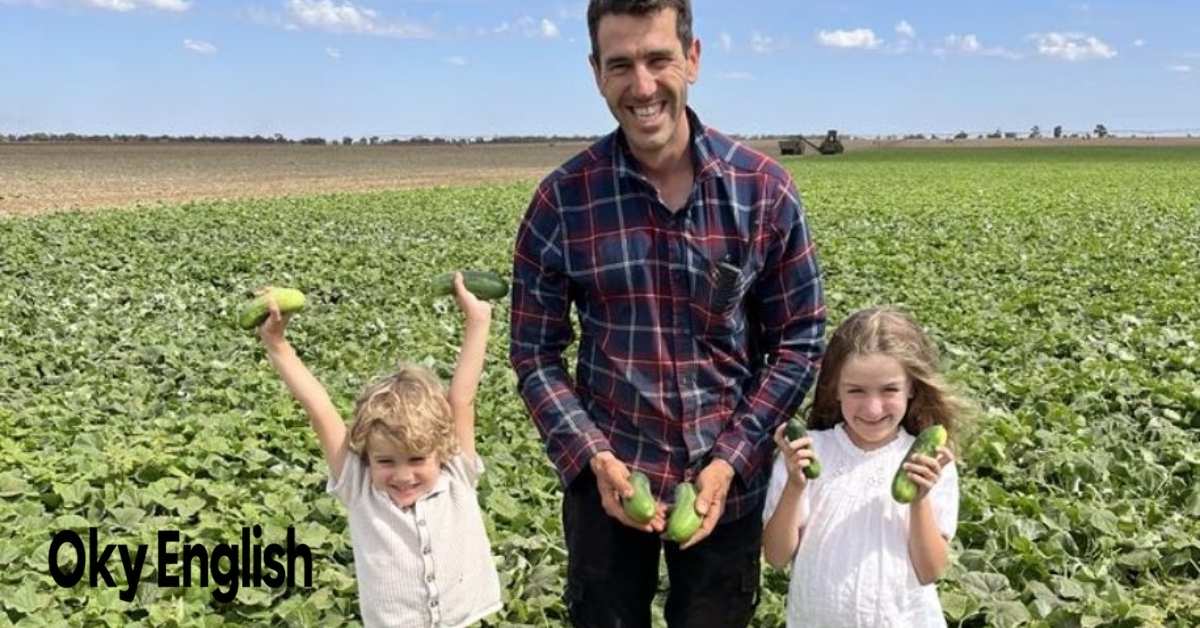
Tony Parle pickles represent a major link between Australian agriculture and the global fast-food industry. Tony Parle, a New South Wales farmer, built a powerful gherkin farming Australia operation in the Riverina region, producing consistent McDonald’s burger pickles for international markets. His system delivers large-scale pickle production, moving from cucumber harvesting to controlled brine fermentation with precision.
Known as the Pickle King Australia, he manages a vertically integrated agribusiness that supplies millions of sliced pickles annually. This network connects local Australian pickle supplier operations to the global food supply chain, ensuring uniform quality, taste, and timing across McDonald’s outlets worldwide, especially in the USA market.
Tony Parle Bio
| Category | Key Fact |
| Subject | Tony Parle pickles production linked to global McDonald’s supply chain |
| Location | Riverina region, New South Wales, Australia |
| Role | Australian pickle supplier and large-scale gherkin farmer |
| Industry Position | Vertically integrated agribusiness in pickle production |
| Annual Output | Approximately 1800 tonnes of pickles per year |
| Global Reach | Supplies McDonald’s burger pickles for international markets including USA |
| Crop Type | Gherkin varieties used for sliced pickles and brine fermentation |
| Harvest Method | Controlled cucumber harvesting within tight seasonal windows |
| Processing | Temperature-controlled fermentation and industrial slicing |
| Business Model | Family-run farming operation scaled into commercial food manufacturing |
| Supply Chain | Integrated into global fast-food logistics system |
| Recognition | Known as “Pickle King Australia” in agricultural industry |
| Key Strength | Consistency in large-volume pickle supply and quality control |
Who Is Tony Parle?
Tony Parle farmer is widely recognized as a key figure in modern Australian agriculture, especially in the world of McDonald’s pickles Australia supply chains. Based in the Riverina region, he represents a generation of growers who turned local farming into a global food supply chain success story. Known in industry circles as the Pickle King, he built his reputation on reliability, scale, and precision.
Rather than staying small, he embraced vertically integrated agribusiness methods, linking planting, harvesting, and processing under one system. This allowed him to meet strict demand from international buyers like McDonald’s. His operations highlight how an Australian pickle supplier can influence food systems far beyond national borders.
In the USA context, his story matters because it explains where everyday McDonald’s burger pickles actually come from. Millions of customers consume his output without realizing the complexity behind it. His farm work is not just agriculture; it is industrial-scale food engineering powered by consistency and timing.
Early Life and Entry Into Farming
Tony Parle grew up surrounded by the rhythms of rural Australia, where farming was not just a job but a lifestyle. As a New South Wales farmer, he learned early how weather, soil, and timing shape survival. The Riverina region gave him both opportunity and challenge, with its fertile land but unpredictable climate.
He began with traditional crops before shifting toward gherkin farming Australia, a decision that would define his career. Early experiments with pickled cucumbers taught him how sensitive crops are to temperature and irrigation. These lessons shaped his later focus on irrigation farming and controlled production systems.
What set him apart was his willingness to scale. While many family farms stayed small, he saw potential in structured supply contracts. This mindset eventually positioned him as a serious McDonald’s pickle supplier, connecting rural fields to global demand in a way few farmers achieve.
The Birth of a Pickle Empire
The transformation from local farmer to industry leader did not happen overnight. Tony Parle built what many now call a family-run pickle business, expanding step by step through reinvestment and careful scaling. His operation evolved into a vertically integrated agribusiness, controlling everything from seed selection to processing.
The breakthrough came when demand for consistent sliced pickles surged across fast-food chains. McDonald’s required uniformity, and Parle’s system delivered. His farms began producing massive volumes, reaching nearly 1800 tonnes pickles annually and supplying over 20 million pickles in peak cycles.
This scale turned him into a trusted Australian food manufacturer, where reliability mattered more than branding. The rise of his operations also earned him the informal title Pickle King Australia, a recognition of dominance in a niche but critical agricultural segment.
His empire was not built on hype but on precision agriculture and disciplined execution.
How the Pickles Are Made
The production of McDonald’s pickles Australia supply follows a tightly controlled agricultural and industrial process. It begins with selecting premium gherkin seed varieties, chosen for size consistency and crunch profile. These seeds are planted using advanced irrigation farming techniques to ensure uniform growth.
Harvesting is extremely time-sensitive. Farmers work within a strict 48-hour harvest window, ensuring cucumbers are picked at peak texture. Any delay can affect quality and fermentation outcomes.
Once harvested, the cucumbers move into temperature controlled processing facilities. Here, the fermentation process begins, often using brine fermentation to stabilize flavor and preserve crunch. This step is essential for producing consistent pickled cucumbers used in fast-food applications.
| Stage | Process | Purpose |
| Harvesting | Cucumber harvesting | Maintain freshness |
| Sorting | Size grading | Ensure uniformity |
| Fermentation | Brine fermentation | Flavor development |
| Slicing | Sliced pickles creation | Fast-food readiness |
This structured system ensures McDonald’s receives predictable quality every time.
Challenges on the Road to Success
The path to becoming a leading McDonald’s pickle supplier was not smooth. Farming in the Riverina region exposes operations to droughts, floods, and shifting temperatures. These conditions can disrupt gherkin farming Australia cycles quickly.
Scaling production also introduced financial pressure. Expanding into food processing facilities required heavy investment and careful risk management. At one point, parts of the operation faced farm receivership recovery, a difficult period that tested long-term resilience.
Global demand added another layer of complexity. Supplying a multinational like McDonald’s meant meeting strict consistency standards while maintaining local production stability. Even small variations in cucumber harvesting timing could affect entire shipments.
Despite these challenges, the business adapted. This resilience became a defining feature of Tony Parle’s reputation, reinforcing his role as a dependable Australian agribusiness success story.
Lessons from the Struggles
The setbacks in Parle’s journey shaped a philosophy centered on control and timing. One major lesson was that agriculture is not just about growing food but managing uncertainty. The unpredictable nature of weather reinforced the need for structured systems in local food production.
Another insight came from supply chain pressure. Working with global buyers showed that even small delays could ripple across the global food supply chain. This pushed improvements in logistics and storage.
His experience with financial restructuring also highlighted the importance of long-term planning in rural entrepreneurship. Rather than reacting to crises, he built buffers into operations.
These lessons turned into operational strengths. Today, his model is often studied as an example of agricultural resilience, where setbacks become the foundation for stronger systems.
Partnership with McDonald’s
The collaboration between Tony Parle and McDonald’s represents one of the most stable pickle supply contract relationships in modern agriculture. It began when McDonald’s needed a consistent supplier for McDonald’s burger pickles, capable of meeting global demand without compromising quality.
Parle’s ability to scale production while maintaining uniformity made him an ideal McDonald’s pickle supplier. His farms integrated directly into McDonald’s supply expectations, ensuring that every batch met strict specifications.
This partnership also strengthened his position as a global supplier. Being part of the global food supply chain meant adapting to international food safety standards and logistics systems.
For McDonald’s USA, this relationship ensures that every burger maintains the same taste profile, no matter the location. It is a quiet but essential part of fast-food consistency.
The Science and Timing Behind Gherkin Farming
Successful gherkin farming Australia depends heavily on timing and environmental control. The process begins with soil preparation and carefully selected gherkin seed varieties suited for fast growth cycles.
Temperature plays a critical role. Even small fluctuations can affect the fermentation process later. Farmers rely on controlled environments to stabilize quality before processing begins.
Harvest timing is precise, often dictated by a narrow 48-hour harvest window. Missing this window can lead to softer textures, which are unsuitable for fast-food standards.
| Factor | Ideal Condition | Impact |
| Temperature | Stable moderate heat | Crisp texture |
| Irrigation | Controlled flow | Uniform growth |
| Harvest timing | 48-hour window | Peak quality |
| Processing | Immediate brine fermentation | Flavor stability |
This scientific approach ensures consistency across millions of units.
Sustainability and Local Impact
Modern Australian food manufacturer operations like Parle’s focus heavily on sustainability. Water-efficient irrigation farming reduces environmental strain, especially in dry regions like the Riverina region.
Soil preservation techniques ensure long-term productivity, protecting farmland for future generations. This approach supports local food production while meeting industrial-scale demand.
His operations also contribute to regional employment, strengthening rural economies. As a New South Wales farmer, his impact extends beyond agriculture into community development.
Sustainability is not just environmental but economic. Balancing scale with responsibility has helped maintain his reputation in global markets.
Public Recognition and Media Coverage
Over time, Tony Parle became known beyond agricultural circles. Media coverage often highlights his role as a Pickle King Australia, focusing on how a rural farmer became part of a global fast-food system.
His work with McDonald’s pickles Australia has been featured in discussions about supply chain transparency. Journalists often point to his operations as an example of how food travels from farm to plate.
Recognition also comes from industry groups that value consistency in pickle production. His ability to deliver 20 million pickles annually reinforces his status as a reliable supplier.
Family and the Human Side
Behind the industrial scale lies a family farming legacy. Like many rural businesses, his operation relies on generational knowledge and shared responsibility. The family-run pickle business structure keeps decision-making grounded.
Life on a large farm is demanding. Balancing production schedules with personal life is not simple, especially during peak harvest seasons.
Still, the human side of farming remains central. Values like patience, discipline, and respect for land guide daily decisions.
Resilience Through Change
Change is constant in agriculture. Climate shifts, market demands, and technological upgrades have all shaped Parle’s journey. His ability to adapt defines his long-term success.
Introducing modern food processing facilities helped improve efficiency and consistency. At the same time, evolving consumer expectations in the USA pushed improvements in quality control.
His story reflects ongoing agricultural resilience, where survival depends on adaptation rather than stability.
Tony Parle’s Legacy
Tony Parle’s legacy sits at the intersection of farming and global commerce. As a leading Australian agribusiness success story, he redefined what a farmer can achieve.
His influence extends across McDonald’s pickles Australia supply chains and into everyday meals in the USA. The scale of gherkin farming Australia under his model demonstrates how agriculture can operate at industrial precision.
More than production, his legacy is about systems. From cucumber fermentation to global logistics, his methods continue to influence modern farming strategies.
Conclusion
The journey of Tony Parle shows how rural farming can evolve into global influence. From the Riverina region to international supply chains, his work connects soil to sandwich in a remarkably structured way.
His role as a McDonald’s pickle supplier highlights the hidden systems behind everyday food. Through precision, resilience, and scale, he helped shape one of the most consistent elements in fast-food culture.
In the end, his story is not just about pickles. It is about how agriculture, when engineered with discipline, becomes part of a global system that feeds millions every day.
FAQs
Who is Tony Parle in relation to McDonald’s pickles?
Tony Parle is an Australian farmer known for supplying McDonald’s pickles through large-scale gherkin farming and a vertically integrated agribusiness system.
Where does Tony Parle grow his pickles?
He grows gherkins in the Riverina region of New South Wales, Australia, using irrigation farming suited for consistent pickle production quality.
How are McDonald’s pickles produced in Australia?
They are made through cucumber harvesting, brine fermentation, slicing, and temperature-controlled processing to ensure uniform taste and crunch.
Why is Tony Parle called the Pickle King?
He earned the nickname due to large-scale production, supplying millions of pickles annually and dominating Australia’s gherkin farming industry.
How many pickles does Tony Parle produce yearly?
His operations have produced around 1800 tonnes annually, equating to tens of millions of sliced pickles for global fast-food supply chains.
What makes Tony Parle’s farming system successful?
His success comes from strict timing, irrigation control, fermentation precision, and integration into a vertically structured agribusiness model.
Does McDonald’s still source pickles from Australia?
Yes, McDonald’s continues to rely on Australian suppliers like Tony Parle for consistent pickle supply in its global burger production network.

Mason Tyler is an American content writer specializing in celebrity news, lifestyle, and achievements, delivering well researched, original, and reliable articles for OkyEnglish with clear, reader focused expertise.